


 CorLab AI Agent
Welcome to your Personal Assistant
This Tech Assistant is designed to support you with clear insights into our company, our work, our services and the people behind our progress.
Powered by CorLab Tech © 2025
Digital Transformation in Healthcare: What It Means in Software Terms
Most of what gets called digital transformation in healthcare is a paper process retyped on a screen. Digital transformation in healthcare is the redesign of clinical and administrative workflows so that data moves between systems, clinicians, and patients without a person re-entering it, using shared standards such as HL7 FHIR.
When a lab result, prescription, or referral leaves one system, it either arrives in the next on its own or someone retypes it. Every retyped field is a delay, a chance for error, and paperwork that was digitized but never changed.
How does process automation fit into digital transformation in healthcare?
Process automation replaces manual, repetitive steps such as eligibility checks, claims submission, and appointment reminders with software that completes them without staff re-entering data. It is usually where healthcare digital transformation starts, because the workflows follow rules and the savings can be measured, though automation alone does not connect clinical systems.
The 2025 CAQH Index estimates that electronic transactions let U.S. healthcare avoid $258 billion in administrative costs in 2024. The same index puts the remaining opportunity at $21 billion, in transactions that are still manual or partly manual, where people retype data between screens.
A reminder system that reads the schedule directly from the practice management system removes work. One that needs a staff member to export a list every morning only moves the retyping. Find where a step's input comes from before automating it.
How does interoperability work in healthcare software?
Interoperability is the ability of separate healthcare systems to exchange data and use it without manual re-entry. In software terms, it rests on shared standards. HL7 FHIR handles API-based exchange, HL7 v2 carries older message feeds, and coded vocabularies such as LOINC keep the meaning of laboratory results intact between systems.
In 2025, 96% of U.S. hospitals engaged in electronically sending records, but 79% engaged in integrating received records without manual entry, according to the Office of the National Coordinator for Health IT (ONC). Sending is nearly universal. Integration, meaning records that land in the EHR without retyping, is where the work remains.
FHIR made this practical for new builds, because every resource has an agreed structure. According to ONC, it organizes data into granular resources that can be created, read, updated, or deleted through standard web operations. In the United States, ONC's Cures Act rule pushed it into certified EHRs: developers with older certified APIs had to provide customers with a standardized FHIR API by December 31, 2022.
ONC's certification criterion for the standardized API covers read access, so pulling data is well supported, while writing data back usually depends on each vendor's own API or on HL7 v2 messages. In its HTI-5 proposal, ONC stated an intent to move beyond read-only interactions. Confirm write-back per vendor instead of assuming it, because "supports FHIR" can mean read access only.
On the live lesson platform build, I had the AI propose questions from slides. The call succeeded and the model returned four good questions, but the parser threw all of them away without an error: the model answered single_choice where the parser accepted only cs, cm and free_text. The prompt had never listed the permitted values.
Clinical systems fail this way too. A laboratory's local code with no mapping gets dropped, and the chart looks normal. Map each code to a shared vocabulary once, and send anything unmapped to a review queue. The standard moves the data; the mapping carries the meaning.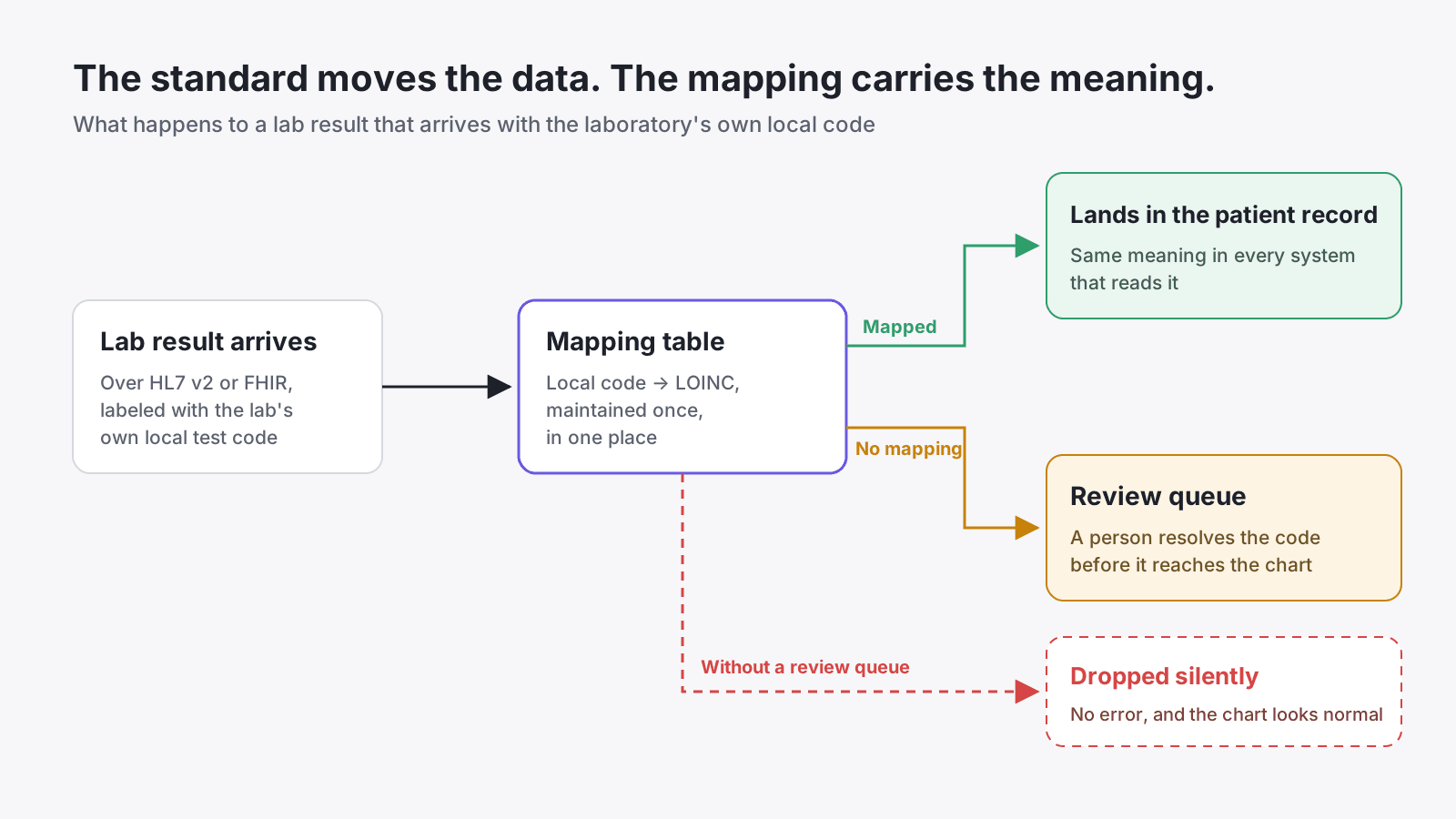
Ten systems wired point to point can need 45 interfaces, each with its own error handling and its own owner, while ten systems connected to a shared API layer need ten connections. HL7 v2 works pair by pair: according to the National Library of Medicine, it depends on agreements between the communicating parties, and its implementations are often highly customized and can take considerable time and resources.
HL7 reported in 2024 that 95% of U.S. healthcare organizations use v2, according to the National Library of Medicine, so new FHIR applications rarely meet a clean slate. A practical design translates between v2 and FHIR at one boundary layer, so new applications speak FHIR while older systems keep running until they are replaced on their own schedule.
The API criterion requires support for authorization through the SMART App Launch framework and OpenID Connect. It also requires the authorization server to revoke an app's access within one hour of a patient's request. Consent, revocation, and audit logs belong in the design of any interface that carries patient data, not in a security review at the end.
If two systems cannot agree that they describe the same person, data fails to connect or attaches to the wrong record. Matching rules, a review queue for uncertain matches, and a named owner for the master patient index come before the first interface goes live.
Hospitals engaged in all four interoperability domains (sending, receiving, finding, and integrating) rose from 23% in 2014 to 76% in 2025, according to ONC. It took eleven years for about three in four hospitals to reach full engagement, a realistic pace for a change that touches every system in the building.
A prototype that moves one record between two test systems proves the format works. It does not prove that production data, with its missing fields, local codes, and duplicate patients, will map cleanly. Budget the mapping work separately from the connection work, because the two fail for different reasons.
Which emerging technologies in healthcare produce point-of-care data?
Wearables, remote patient monitors, and connected ambulances produce point-of-care data: measurements captured where the patient is, not where the record lives. These emerging technologies in healthcare matter only when readings reach the clinical record as structured data, such as FHIR Observation resources, instead of staying inside a vendor's app.
A connected ambulance shows both the value and the difficulty. Vital signs captured on the way can reach the emergency department before the patient does, but only if the ambulance's devices, the dispatch system, and the hospital's EHR agree on a data format in advance. The constraint is usually the data contract between the systems, not the hardware. Someone also has to own reading the feed once the ambulance arrives.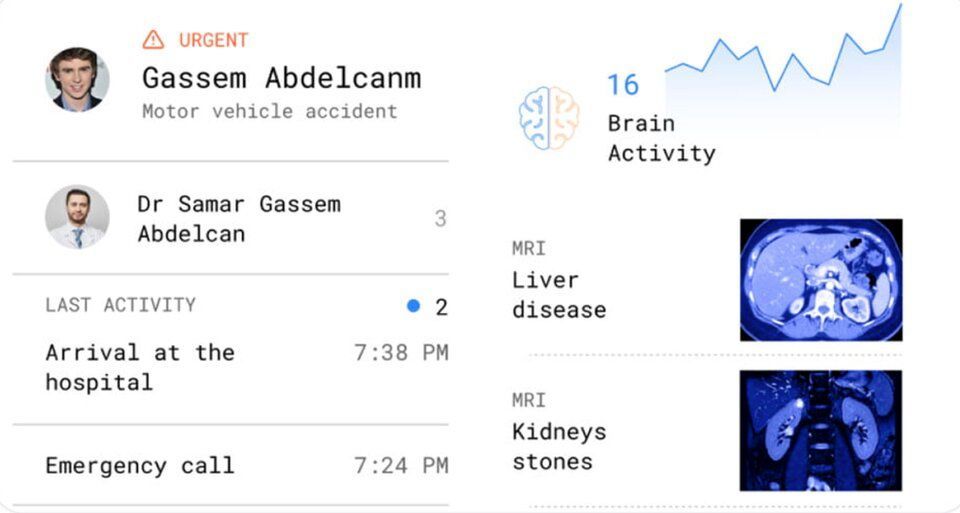
Wearables can produce thousands of readings a day, while a clinician needs a trend and a flag. Summaries enter the record as HL7 Observation resources, with the share of missing data shown beside each number, so a signal dropout is never mistaken for a normal day.
Three things decide whether a monitoring feed is ready for clinical use. Each data stream needs recorded consent, the signal has to be clean enough to act on, and a named person has to own the response when a reading crosses a threshold overnight. Our article on IoT in healthcare covers the monitoring side.
How do patient-facing systems change access to care?
Patient-facing systems, including portals, health apps, and telemedicine, give patients direct access to their records, appointments, and clinicians. They matter for transformation when they read from the same data the clinic uses, so patients see current results and providers do not maintain a second copy.
Telemedicine now looks like a steady part of care rather than a spike. In the second quarter of 2026, 18.3% of commercially insured patients had a telehealth claim, and telehealth made up 5.6% of medical claim lines, according to FAIR Health. Those shares are modest overall, which suggests virtual visits sit alongside in-person care rather than replacing it. Both figures cover commercially insured patients only.
The Office of the Assistant Secretary for Technology Policy reports that 65% of individuals nationwide were offered and accessed an online medical record or patient portal in 2024, up from 25% in 2014. That access is fragmented: 59% had multiple portals, and only 7% used an app to combine them.
When each provider runs its own portal, the patient becomes the integration layer, carrying results from one login to another. Standards-based APIs let a single app read from many systems, which is why FHIR sits underneath patient access rules in the United States.
Platforms that match clinicians to short shifts or same-day visits need schedules, credentials, and records to be readable across sites. If each site keeps its own copy, clinicians re-enter what the patient already said, and the flexibility stops at the front door.
What does analytics add once the data is connected?
Analytics turns connected data into decisions: forecasting demand, flagging patients at risk, and showing where processes stall. It depends on the layers beneath it, because a model trained on incomplete or retyped data learns the errors along with the patterns, and clinical models also need validated data and clinician oversight.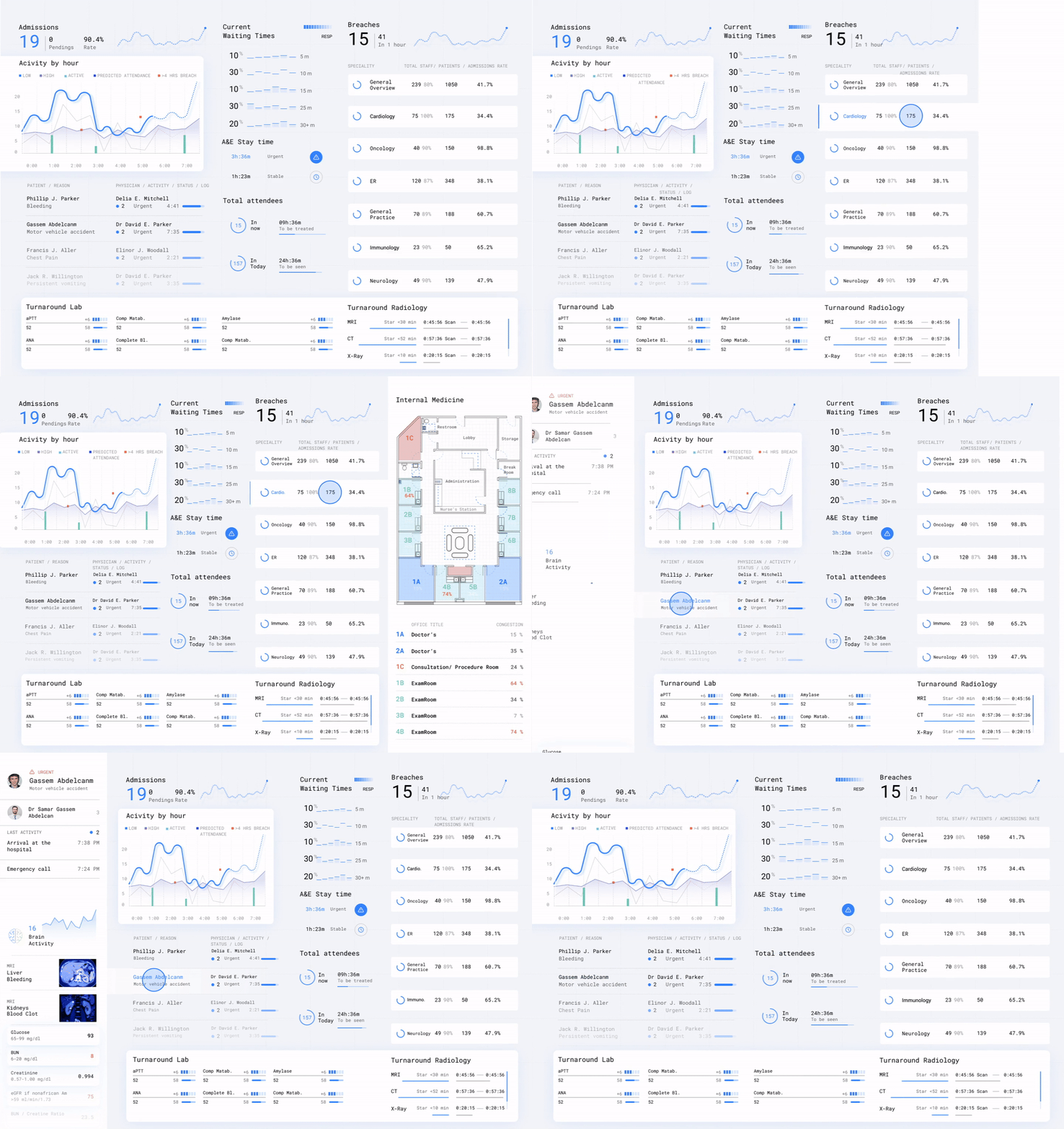
The 2025 CAQH Index found that more than half of health plans and a quarter of provider organizations use AI tools in administrative workflows. Clinical models need validation against local data before a clinician acts on them. Our article on machine learning in healthcare covers the use cases.
Sample data is cleaner than production data, so a model that performs on a sample proves little. Ask where the training data came from, how often it is refreshed, and what happens to a prediction when a source system is down. The answers show whether the analytics layer sits on real integration or on a one-time export.
Moldova's e-prescription system replaced one paper form with one data flow
A patient in Moldova now collects reimbursed medicines at a pharmacy with an identity card and no paper prescription. The National Health Insurance Company (CNAM), with the Ministry of Health, launched the system, called eRețeta, on April 2, 2024. It replaced the paper prescription for reimbursed medicines and medical devices, according to CNAM.
What the system connects to is the design point. The state news agency Moldpres reported on a CNAM press conference in March 2026. It said the system is integrated with the compulsory health insurance information system, the population register, and the lists of reimbursed medicines and devices. Identity, insurance status, and reimbursement rules therefore come from registers, not from a form.
At that press conference, CNAM's director told Moldpres that more than 900,000 distinct beneficiaries, about 38% of the population, had used the system in its first two years. Doctors had issued 15 million electronic prescriptions. More than 2,500 doctors and about 3,000 pharmacists use it actively, and a CNAM department head added that the insurer can monitor consumption in real time and forecast spending.
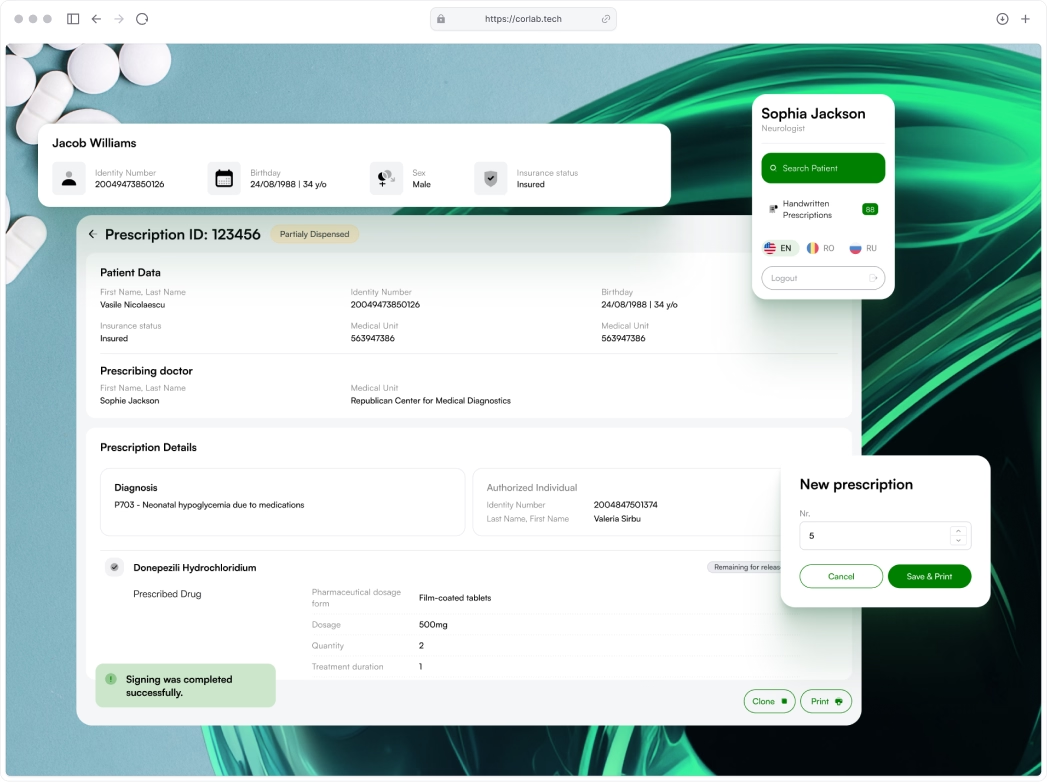
Our published case study describes the national prescribing platform as built with the state health insurer and in production 11 months after the project started. Doctors prescribe medicines and medical devices in one place. Pharmacists find a patient by personal identification number or ID scan and can dispense only valid prescriptions. The architecture is microservices-based, with digital signatures and role-based access.
A national system keeps changing after launch. In January 2026, the Ministry of Health announced 14 functional upgrades to eRețeta, including several diagnoses on one prescription and automatic price caps and reimbursement rules. Our article on e-prescribing in Moldova covers the workflow.
In June 2026, CNAM's director told Logos Press that the institution manages 14 information systems. All of them are meant to be integrated into a future national electronic health record, whose concept the Ministry of Health is still developing. Until then, each system holds part of a patient's history.
Why do healthcare digital transformations stall?
Healthcare digital transformations stall on legacy systems, procurement cycles, and data quality, not on a lack of technology. Older systems expose data through interfaces never designed for exchange, purchasing calendars often set the pace of a rollout, and inconsistent codes and duplicate patient records make connected data unreliable.
A hospital may run an EHR from one decade, a laboratory system from another, and a billing system that exports files overnight. The ONC figures in the interoperability section fit the pattern. Sending a record is a transport problem, integrating it without manual entry is a mapping problem, and older systems were rarely built for it. An integration layer has to reconcile their formats.
On the same build, two requirements were each reasonable and incoherent together. One said the AI proposes questions from the text of the slide, the other said it must ground itself in the topic's source materials. The implementation followed the second, so a teacher who had just uploaded a deck could not use the AI at all. We fixed the specification first and the code second.
Procurement fixes requirements the same way, early and in writing, before anyone has tested them together. Vendor onboarding adds its own lead time. Under ONC rules, a certified EHR developer has up to 10 business days to verify an app developer and 5 more to enable production access, so each EHR connection can add three weeks. Those weeks belong in the plan as their own line item.
Duplicate patient records, local laboratory codes, and free-text diagnoses pass unnoticed in a paper-style workflow because a person reads around them. Connect the systems and the errors surface at once, so teams often discover data problems only after the interface works.
Each barrier has a practical response. For legacy systems, wrap them in an integration layer instead of replacing them first. For procurement, ask for sandbox access and message samples at the start, not after the contract. For data quality, profile the real data before designing the interface, and assign an owner to each code set.
Start with a diagnostic instead of a technology choice. List every place staff retype data between two systems, and count them. The count shows where a transformation would pay off and which barrier blocks each place, so the plan follows the workflows.
Most of what gets called digital transformation in healthcare is a paper process retyped on a screen. Digital transformation in healthcare is the redesign of clinical and administrative workflows so that data moves between systems, clinicians, and patients without a person re-entering it, using shared standards such as HL7 FHIR.
When a lab result, prescription, or referral leaves one system, it either arrives in the next on its own or someone retypes it. Every retyped field is a delay, a chance for error, and paperwork that was digitized but never changed.
How does process automation fit into digital transformation in healthcare?
Process automation replaces manual, repetitive steps such as eligibility checks, claims submission, and appointment reminders with software that completes them without staff re-entering data. It is usually where healthcare digital transformation starts, because the workflows follow rules and the savings can be measured, though automation alone does not connect clinical systems.
The 2025 CAQH Index estimates that electronic transactions let U.S. healthcare avoid $258 billion in administrative costs in 2024. The same index puts the remaining opportunity at $21 billion, in transactions that are still manual or partly manual, where people retype data between screens.
A reminder system that reads the schedule directly from the practice management system removes work. One that needs a staff member to export a list every morning only moves the retyping. Find where a step's input comes from before automating it.
How does interoperability work in healthcare software?
Interoperability is the ability of separate healthcare systems to exchange data and use it without manual re-entry. In software terms, it rests on shared standards. HL7 FHIR handles API-based exchange, HL7 v2 carries older message feeds, and coded vocabularies such as LOINC keep the meaning of laboratory results intact between systems.
In 2025, 96% of U.S. hospitals engaged in electronically sending records, but 79% engaged in integrating received records without manual entry, according to the Office of the National Coordinator for Health IT (ONC). Sending is nearly universal. Integration, meaning records that land in the EHR without retyping, is where the work remains.
FHIR made this practical for new builds, because every resource has an agreed structure. According to ONC, it organizes data into granular resources that can be created, read, updated, or deleted through standard web operations. In the United States, ONC's Cures Act rule pushed it into certified EHRs: developers with older certified APIs had to provide customers with a standardized FHIR API by December 31, 2022.
ONC's certification criterion for the standardized API covers read access, so pulling data is well supported, while writing data back usually depends on each vendor's own API or on HL7 v2 messages. In its HTI-5 proposal, ONC stated an intent to move beyond read-only interactions. Confirm write-back per vendor instead of assuming it, because "supports FHIR" can mean read access only.
On the live lesson platform build, I had the AI propose questions from slides. The call succeeded and the model returned four good questions, but the parser threw all of them away without an error: the model answered single_choice where the parser accepted only cs, cm and free_text. The prompt had never listed the permitted values.
Clinical systems fail this way too. A laboratory's local code with no mapping gets dropped, and the chart looks normal. Map each code to a shared vocabulary once, and send anything unmapped to a review queue. The standard moves the data; the mapping carries the meaning.
Ten systems wired point to point can need 45 interfaces, each with its own error handling and its own owner, while ten systems connected to a shared API layer need ten connections. HL7 v2 works pair by pair: according to the National Library of Medicine, it depends on agreements between the communicating parties, and its implementations are often highly customized and can take considerable time and resources.
HL7 reported in 2024 that 95% of U.S. healthcare organizations use v2, according to the National Library of Medicine, so new FHIR applications rarely meet a clean slate. A practical design translates between v2 and FHIR at one boundary layer, so new applications speak FHIR while older systems keep running until they are replaced on their own schedule.
The API criterion requires support for authorization through the SMART App Launch framework and OpenID Connect. It also requires the authorization server to revoke an app's access within one hour of a patient's request. Consent, revocation, and audit logs belong in the design of any interface that carries patient data, not in a security review at the end.
If two systems cannot agree that they describe the same person, data fails to connect or attaches to the wrong record. Matching rules, a review queue for uncertain matches, and a named owner for the master patient index come before the first interface goes live.
Hospitals engaged in all four interoperability domains (sending, receiving, finding, and integrating) rose from 23% in 2014 to 76% in 2025, according to ONC. It took eleven years for about three in four hospitals to reach full engagement, a realistic pace for a change that touches every system in the building.
A prototype that moves one record between two test systems proves the format works. It does not prove that production data, with its missing fields, local codes, and duplicate patients, will map cleanly. Budget the mapping work separately from the connection work, because the two fail for different reasons.
Which emerging technologies in healthcare produce point-of-care data?
Wearables, remote patient monitors, and connected ambulances produce point-of-care data: measurements captured where the patient is, not where the record lives. These emerging technologies in healthcare matter only when readings reach the clinical record as structured data, such as FHIR Observation resources, instead of staying inside a vendor's app.
A connected ambulance shows both the value and the difficulty. Vital signs captured on the way can reach the emergency department before the patient does, but only if the ambulance's devices, the dispatch system, and the hospital's EHR agree on a data format in advance. The constraint is usually the data contract between the systems, not the hardware. Someone also has to own reading the feed once the ambulance arrives.
Wearables can produce thousands of readings a day, while a clinician needs a trend and a flag. Summaries enter the record as HL7 Observation resources, with the share of missing data shown beside each number, so a signal dropout is never mistaken for a normal day.
Three things decide whether a monitoring feed is ready for clinical use. Each data stream needs recorded consent, the signal has to be clean enough to act on, and a named person has to own the response when a reading crosses a threshold overnight. Our article on IoT in healthcare covers the monitoring side.
How do patient-facing systems change access to care?
Patient-facing systems, including portals, health apps, and telemedicine, give patients direct access to their records, appointments, and clinicians. They matter for transformation when they read from the same data the clinic uses, so patients see current results and providers do not maintain a second copy.
Telemedicine now looks like a steady part of care rather than a spike. In the second quarter of 2026, 18.3% of commercially insured patients had a telehealth claim, and telehealth made up 5.6% of medical claim lines, according to FAIR Health. Those shares are modest overall, which suggests virtual visits sit alongside in-person care rather than replacing it. Both figures cover commercially insured patients only.
The Office of the Assistant Secretary for Technology Policy reports that 65% of individuals nationwide were offered and accessed an online medical record or patient portal in 2024, up from 25% in 2014. That access is fragmented: 59% had multiple portals, and only 7% used an app to combine them.
When each provider runs its own portal, the patient becomes the integration layer, carrying results from one login to another. Standards-based APIs let a single app read from many systems, which is why FHIR sits underneath patient access rules in the United States.
Platforms that match clinicians to short shifts or same-day visits need schedules, credentials, and records to be readable across sites. If each site keeps its own copy, clinicians re-enter what the patient already said, and the flexibility stops at the front door.
What does analytics add once the data is connected?
Analytics turns connected data into decisions: forecasting demand, flagging patients at risk, and showing where processes stall. It depends on the layers beneath it, because a model trained on incomplete or retyped data learns the errors along with the patterns, and clinical models also need validated data and clinician oversight.
The 2025 CAQH Index found that more than half of health plans and a quarter of provider organizations use AI tools in administrative workflows. Clinical models need validation against local data before a clinician acts on them. Our article on machine learning in healthcare covers the use cases.
Sample data is cleaner than production data, so a model that performs on a sample proves little. Ask where the training data came from, how often it is refreshed, and what happens to a prediction when a source system is down. The answers show whether the analytics layer sits on real integration or on a one-time export.
Moldova's e-prescription system replaced one paper form with one data flow
A patient in Moldova now collects reimbursed medicines at a pharmacy with an identity card and no paper prescription. The National Health Insurance Company (CNAM), with the Ministry of Health, launched the system, called eRețeta, on April 2, 2024. It replaced the paper prescription for reimbursed medicines and medical devices, according to CNAM.
What the system connects to is the design point. The state news agency Moldpres reported on a CNAM press conference in March 2026. It said the system is integrated with the compulsory health insurance information system, the population register, and the lists of reimbursed medicines and devices. Identity, insurance status, and reimbursement rules therefore come from registers, not from a form.
At that press conference, CNAM's director told Moldpres that more than 900,000 distinct beneficiaries, about 38% of the population, had used the system in its first two years. Doctors had issued 15 million electronic prescriptions. More than 2,500 doctors and about 3,000 pharmacists use it actively, and a CNAM department head added that the insurer can monitor consumption in real time and forecast spending.
Our published case study describes the national prescribing platform as built with the state health insurer and in production 11 months after the project started. Doctors prescribe medicines and medical devices in one place. Pharmacists find a patient by personal identification number or ID scan and can dispense only valid prescriptions. The architecture is microservices-based, with digital signatures and role-based access.
A national system keeps changing after launch. In January 2026, the Ministry of Health announced 14 functional upgrades to eRețeta, including several diagnoses on one prescription and automatic price caps and reimbursement rules. Our article on e-prescribing in Moldova covers the workflow.
In June 2026, CNAM's director told Logos Press that the institution manages 14 information systems. All of them are meant to be integrated into a future national electronic health record, whose concept the Ministry of Health is still developing. Until then, each system holds part of a patient's history.
Why do healthcare digital transformations stall?
Healthcare digital transformations stall on legacy systems, procurement cycles, and data quality, not on a lack of technology. Older systems expose data through interfaces never designed for exchange, purchasing calendars often set the pace of a rollout, and inconsistent codes and duplicate patient records make connected data unreliable.
A hospital may run an EHR from one decade, a laboratory system from another, and a billing system that exports files overnight. The ONC figures in the interoperability section fit the pattern. Sending a record is a transport problem, integrating it without manual entry is a mapping problem, and older systems were rarely built for it. An integration layer has to reconcile their formats.
On the same build, two requirements were each reasonable and incoherent together. One said the AI proposes questions from the text of the slide, the other said it must ground itself in the topic's source materials. The implementation followed the second, so a teacher who had just uploaded a deck could not use the AI at all. We fixed the specification first and the code second.
Procurement fixes requirements the same way, early and in writing, before anyone has tested them together. Vendor onboarding adds its own lead time. Under ONC rules, a certified EHR developer has up to 10 business days to verify an app developer and 5 more to enable production access, so each EHR connection can add three weeks. Those weeks belong in the plan as their own line item.
Duplicate patient records, local laboratory codes, and free-text diagnoses pass unnoticed in a paper-style workflow because a person reads around them. Connect the systems and the errors surface at once, so teams often discover data problems only after the interface works.
Each barrier has a practical response. For legacy systems, wrap them in an integration layer instead of replacing them first. For procurement, ask for sandbox access and message samples at the start, not after the contract. For data quality, profile the real data before designing the interface, and assign an owner to each code set.
Start with a diagnostic instead of a technology choice. List every place staff retype data between two systems, and count them. The count shows where a transformation would pay off and which barrier blocks each place, so the plan follows the workflows.
Frequently asked questions

What does digital transformation in healthcare mean?
Digital transformation in healthcare means redesigning clinical and administrative workflows so that data moves between systems, clinicians, and patients without anyone re-entering it. In software terms, that combines shared standards such as HL7 FHIR, automation of routine transactions, and patient-facing access. Digitizing a paper form without connecting it to other systems is not transformation.

What are examples of digital transformation in healthcare industry projects?
What are the benefits of digital transformation in healthcare?
What barriers slow digital transformation in healthcare?
What drives the cost of digital transformation in healthcare?
Where should a healthcare organization start with digital transformation?
How long does digital transformation in healthcare take?

Author
With more than 10 years in full-stack development and real-world experience in healthcare, I bring a unique blend of technical skills and domain knowledge to every project. My focus is on building solutions that solve real problems and support better outcomes.
I often bring AI into the mix to enhance performance and simplify the complex. It’s all about creating smarter tools that help people work more efficiently and make better decisions.


Our Best Insights
Browse More Articles
Want to know what’s trending in the tech world? Our articles break it all down - quickly and clearly.
 Time to read: 11 min
Healthcare
March 12th, 2025
E-Prescribing Systems: How They Work, and What a National Rollout Involves
The growing adoption of E-prescribing in Moldova points to a larger trend toward smarter, more connected digital healthcare systems.

 Time to read: 11 min
Healthcare

Artificial Intelligence
November 4th, 2024
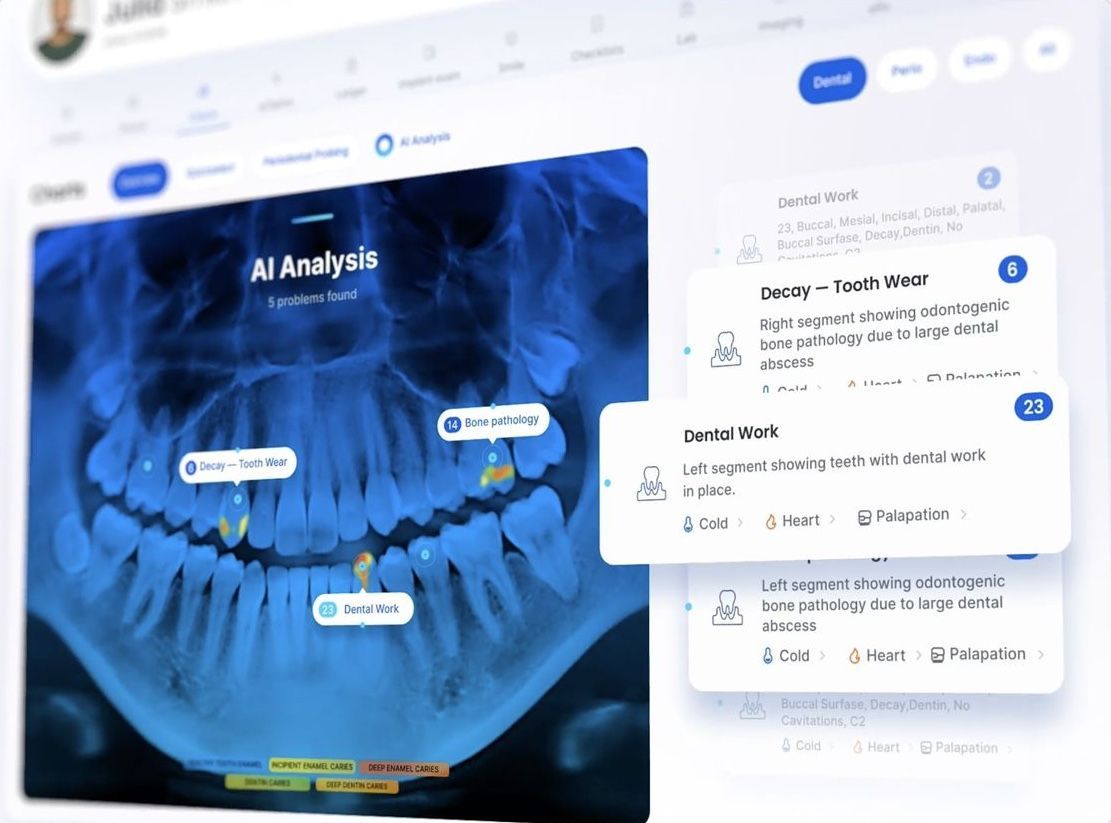
Machine Learning in Healthcare: Benefits, Use Cases, and Limits
Where machine learning helps in healthcare, why so many projects stall after the pilot, and when a simple rule beats a model.


Thinking about building your own app?
Let's make it happen! Dream big, build smart - we’ll take care of the tech.
 Get a free consultation