


 CorLab AI Agent

Welcome to your Personal Assistant
This Tech Assistant is designed to support you with clear insights into our company, our work, our services and the people behind our progress.
Powered by CorLab Tech © 2025
E-Prescribing Systems: How They Work, and What a National Rollout Involves
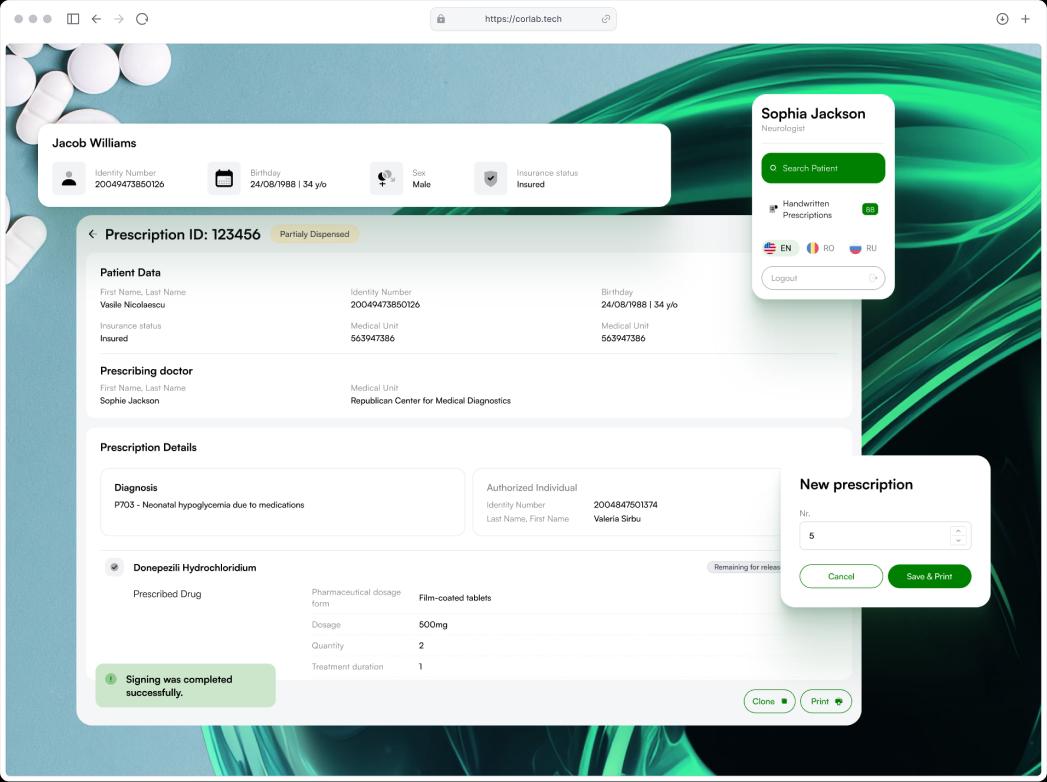
An e-prescribing system is software that lets a clinician create, sign, and send a prescription electronically, so a pharmacy can dispense against it and record what it dispensed. It replaces the paper slip with a structured record that the prescriber, the pharmacist, and the payer all read the same way.
A national e-prescribing system adds the shared layers a single clinic never needs. Those are verified identity for every prescriber and pharmacist, national registries of patients and medicines, a full audit trail, and uptime that every pharmacy depends on at once. This guide covers the data flow, the national layers, and a worked example from Moldova.
How does e-prescribing work?
E-prescribing works as a four-step data flow from prescriber to central registry to pharmacy to a recorded dispensation. Each step checks the one before it. The registry validates the prescription, the pharmacy validates the registry record, and the dispensation record closes the loop so the same prescription cannot be filled twice.
The flow starts with the prescriber. A doctor selects the patient, picks the medicine from a shared list of authorized products, and sets the dose and duration. Before signing, the electronic prescribing system can check for drug interactions, allergies, and reimbursement rules. The doctor then signs the prescription electronically, which ties it to a verified identity rather than a handwritten signature.
A structured prescription carries more than a paper slip ever did. Beyond the medicine and dose, it holds coded identifiers for the patient, prescriber, and facility, a diagnosis code where reimbursement needs one, a validity period, and a status. Those fields are what let every later check run automatically instead of relying on a pharmacist's reading of the page. Missing fields are caught at creation, not at the counter.
Next, the central registry receives the signed prescription and checks it before anything else happens. It confirms that the structure is complete, that the prescriber has the right to issue it, that the patient exists, and that any reimbursement claim fits the rules. A valid prescription gets a unique identifier and a status, usually issued, that every later step reads.
At the pharmacy, the pharmacist looks up the prescription by patient or by prescription number and checks its status. An issued prescription can be dispensed. One that is already dispensed, expired, or cancelled cannot, which removes a whole class of duplicate fills and forged slips that paper allows. It also puts the prescriber's details in front of the pharmacist whenever a question comes up.
Real prescriptions do not always end in one visit. A pharmacy may have only part of the quantity, a patient may collect a repeat supply next month, or a doctor may cancel a medicine after an adverse reaction. The system has to model each of these as a status change, such as partially dispensed or cancelled, so that every pharmacy sees the same current state.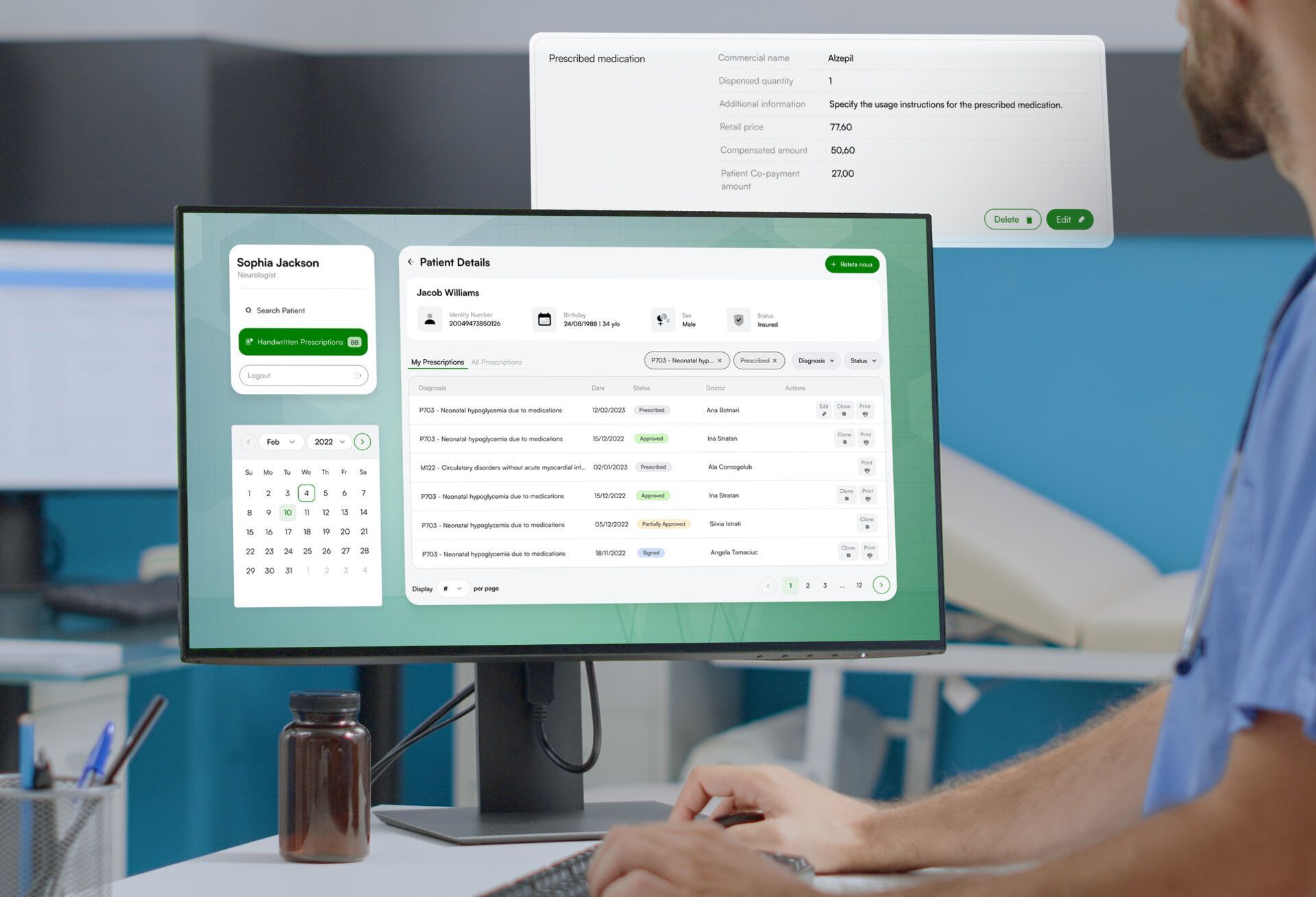
The dispensation record is the last step, and teams often underbuild it. It stores what was actually dispensed, in what quantity, at what price, and how much the payer reimbursed. It also changes the prescription's status, so the registry knows the loop is closed. Without that record, the system knows what was prescribed but not what the patient received.
Standards carry this flow between systems. In HL7 FHIR, the prescription is a MedicationRequest and the dispensation is a MedicationDispense, which lets a clinic's records system and a pharmacy's software exchange the same data. In the United States, pharmacy messaging also runs on the NCPDP SCRIPT standard. A national system can define its own interface, but mapping it to these models early makes later integrations cheaper.
What does a national e-prescribing system add?
A national e-prescribing system adds four layers that a single clinic's own tool never needs. Those are verified identity for every prescriber and pharmacist, shared national registries, a complete audit trail, and availability that thousands of pharmacies rely on at the same moment. Each layer is its own engineering project.
Identity comes first because a prescription is a legal instruction. Prescribers usually sign through a national electronic identity or signature service, and pharmacists log in the same way. That makes the signing service a dependency the whole system shares. When it is slow, prescribing is slow everywhere, and when it stops, nobody can sign. In the United States, controlled substances add a further requirement: two-factor signing for every such prescription.
Registries are the second layer. The system needs a current list of patients, prescribers, pharmacies, and authorized medicines with their reimbursement status. Each list is usually owned by a different institution and updated on its own schedule. A medicine removed from the reimbursement list on Monday must disappear from prescribing screens on Monday, or pharmacies will dispense items the payer will not cover.
Reimbursement rules usually sit on top of the registries. They decide which patients qualify for which medicines, at what share of the price, and under which diagnoses. Keeping those rules in a configurable engine, rather than in code, lets the payer change a rule without a software release, which matters when policy changes arrive with short notice. Each rule change needs a version and a start date.
The audit trail is the third layer. Every creation, view, change, cancellation, and dispensation needs a record of who did it and when. Insurers use that trail to reconcile payments, regulators use it to follow controlled medicines, and engineers use it to explain any disputed prescription. A trail that can be edited after the fact is not an audit trail. It should be append-only by design.
Access control belongs to the same layer. A prescription contains health data, so a pharmacist should see what they need to dispense and no more, and a prescriber should see the patient's prescriptions only when treating them. Every access is logged, and patients should be able to see who viewed their records.
Availability is the fourth layer, and it changes the whole architecture. A clinic tool can go down for an evening. A national system cannot, because pharmacies open early and close late across the country. That means redundant infrastructure, monitoring on every external dependency, and a documented fallback procedure for the hours when a shared service fails. Every hour of planned downtime has to be agreed with pharmacies in advance.
Load is uneven. Prescribing peaks in clinic hours and dispensing peaks after work, so a national system has to be sized and load-tested for those peaks. A slow counter at 6 p.m. looks like an outage to the patient waiting at it. Whether to build these layers or adapt an existing product is weighed in the guide to custom healthcare software development.
How we built Moldova's national e-prescribing system
The night before Moldova's national e-prescribing platform went live, MSign froze. MSign is the government's electronic signature service, and every prescriber signs through it. We were all in a room, watching the screens, while nobody in the country could sign a prescription. It took about two hours to get signing working again, and the platform restarted just before midnight.
We built that platform, eRețeta, with the National Medical Insurance Company (CNAM) in about 11 months. Doctors issue prescriptions from their medical records systems, pharmacies view and dispense them through a central interface, and the insurer tracks the whole flow in real time. The platform covers medical devices as well as medicines. Prescriptions and dispensations run through the same central platform, so every party works from one record.
Three integration points shape the platform. We connected the medical records systems where doctors already work, MSign for signing, and a central interface that pharmacies use to find and dispense prescriptions. CNAM's real-time tracking sits across all three, so the insurer follows each prescription from issue to dispensation.
eRețeta currently handles subsidized prescriptions, the ones whose cost the state partially covers. Before the national launch, doctors and pharmacists in Hîncești used the platform in a pilot. Today it is live across more than 1,400 providers and 1,688 pharmacies and serves more than 500,000 patients. The e-prescription case study and the healthcare industry page cover the scope in more detail.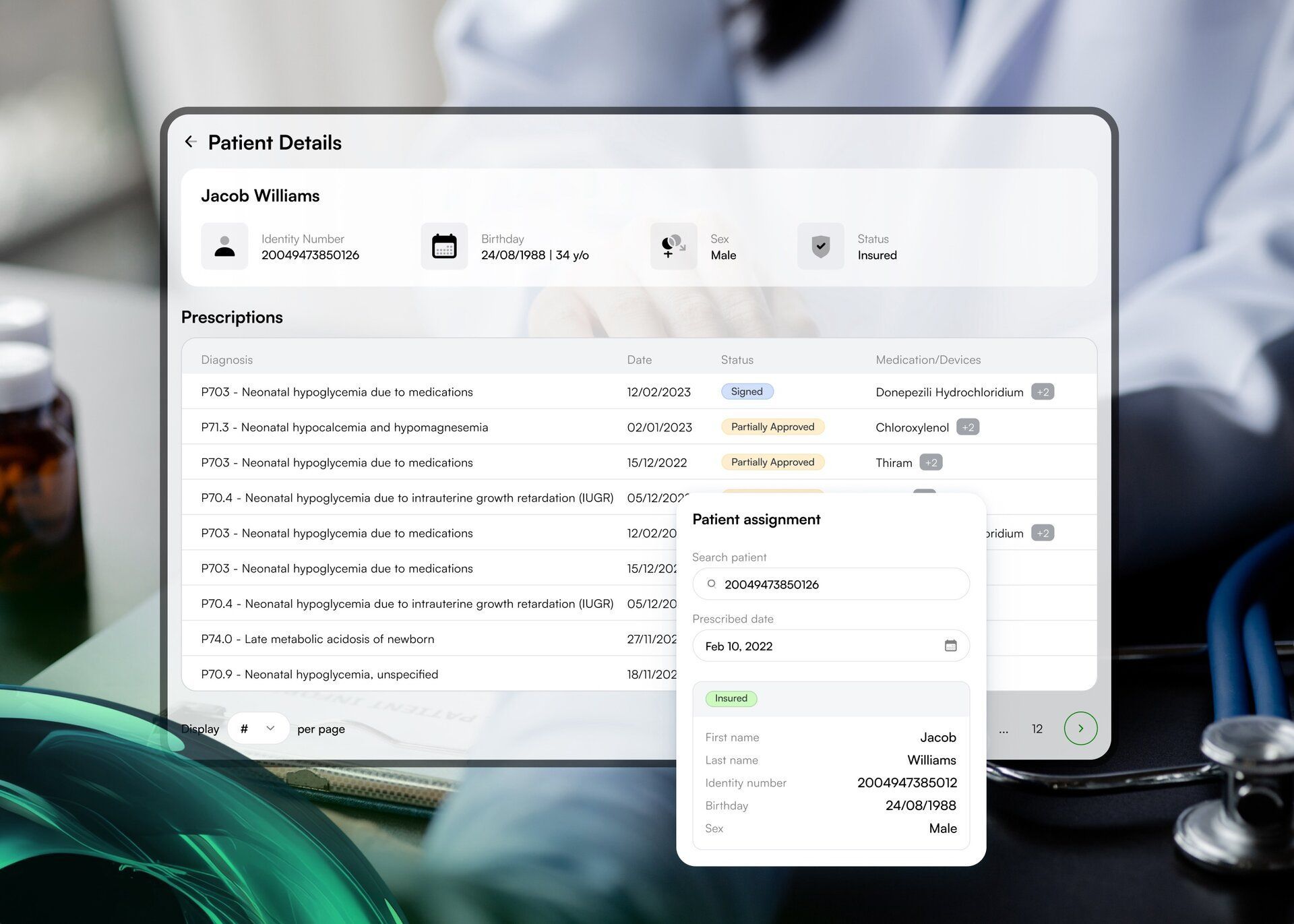
That launch night shows what national scale means in practice. The platform's own code was ready, and a shared service outside it still stopped prescribing everywhere. A national build therefore needs monitoring on every external dependency, a fallback for the hours when one fails, and a launch plan that assumes something outside the team's control will break.
What are the benefits of e-prescribing?
The benefits of e-prescribing are fewer prescribing errors, no illegible prescriptions, and a complete record of what was prescribed and dispensed. Most of the published evidence concerns errors. Savings in time and money are real but harder to measure, because they depend on how paper-based the previous process was.
Error evidence is concrete. A study from Weill Cornell Medical College followed community practices that adopted e-prescribing with decision support. Their error rate fell from 42.5 to 6.6 per 100 prescriptions after one year, while practices that stayed on paper held steady at around 38. Illegibility errors among adopters fell from 87.6 per 100 prescriptions to zero.
That study was small, with 15 prescribers in each group, so its numbers describe a direction more than a national forecast. Adoption itself is no longer the exception in Europe. The World Health Organization Regional Office for Europe reports that 82 percent of its Member States routinely make prescriptions available electronically.
A national system adds benefits that a single clinic cannot see. The payer can check reimbursement at the counter instead of weeks later, and health authorities can follow how medicines are prescribed across regions and spot unusual patterns. Patients can collect a prescription at any connected pharmacy, because the record lives in the registry and not on a slip of paper.
Pharmacists gain time at the counter. Instead of deciphering handwriting or calling a clinic to confirm a dose, they read a structured record that the registry has already validated. That time goes back to talking with the patient, where pharmacists add real value.
E-prescribing also creates errors of its own, and honest planning includes them. A case series in the Society of General Internal Medicine's journal describes pharmacies dispensing medicines that doctors had already stopped, because the software sent new prescriptions and refills but not discontinuations. The fix is a cancellation message that travels as reliably as the prescription itself.
No e-prescribing system fixes a wrong clinical decision. A clean, legible prescription for the wrong medicine is still wrong. Decision support catches some of these cases, such as known interactions, but the prescriber remains responsible for the choice, and the interface should never suggest otherwise.
What slows e-prescribing adoption?
E-prescribing adoption slows when the digital flow is harder than paper for someone in the chain, usually the pharmacist or a busy prescriber. Once people work around the system to keep patients moving, its data stops matching what actually happens in practice.
Workarounds are well documented. A study of Greece's national ePrescription rollout, indexed by the U.S. National Library of Medicine, found pharmacists bypassing the application entirely or using it at a different time than the process required. Each workaround had a practical reason behind it, which makes workarounds useful evidence about where the design needs to change.
A pilot region is an inexpensive place to find those reasons. Real prescribers and pharmacists meet the real flow, with real internet connections and real queues, before the whole country depends on it. Moldova's rollout followed that pattern, with doctors and pharmacists in Hîncești using the platform before the national launch.
Training works well at the point of use. Short sessions at the pharmacy counter and in the clinic, built around the tasks people repeat every day, beat long manuals. Support lines need clinical and pharmacy knowledge as well as technical knowledge, because most early calls are about workflow rather than bugs. The first weeks after launch need extra support staff.
Fallback procedures matter as much as features. Every national system needs a documented answer to one question: what does a pharmacist do when the signing service, the registry, or the network is down and a patient is waiting? A clear offline procedure, with reconciliation once services return, protects patients and keeps pharmacists from inventing their own. Pharmacists should rehearse it before launch, not during the first outage.
Paper and digital usually coexist for a while. Some prescribers will keep writing slips, and some prescription types will stay outside the system at first, as subsidized-only scopes do. The transition plan should say which prescriptions must be electronic from which date, so pharmacies are not left guessing which paper slips are still valid.
Registry quality decides trust. If the list of authorized medicines lags behind the regulator, prescribers see items they cannot prescribe and pharmacies reject valid ones. Automating registry updates, and showing each registry's last update time, removes a steady source of support calls. More on how these systems fit a wider modernization is in the guide to digital transformation in healthcare software development.
An e-prescribing system is software that lets a clinician create, sign, and send a prescription electronically, so a pharmacy can dispense against it and record what it dispensed. It replaces the paper slip with a structured record that the prescriber, the pharmacist, and the payer all read the same way.
A national e-prescribing system adds the shared layers a single clinic never needs. Those are verified identity for every prescriber and pharmacist, national registries of patients and medicines, a full audit trail, and uptime that every pharmacy depends on at once. This guide covers the data flow, the national layers, and a worked example from Moldova.
How does e-prescribing work?
E-prescribing works as a four-step data flow from prescriber to central registry to pharmacy to a recorded dispensation. Each step checks the one before it. The registry validates the prescription, the pharmacy validates the registry record, and the dispensation record closes the loop so the same prescription cannot be filled twice.
The flow starts with the prescriber. A doctor selects the patient, picks the medicine from a shared list of authorized products, and sets the dose and duration. Before signing, the electronic prescribing system can check for drug interactions, allergies, and reimbursement rules. The doctor then signs the prescription electronically, which ties it to a verified identity rather than a handwritten signature.
A structured prescription carries more than a paper slip ever did. Beyond the medicine and dose, it holds coded identifiers for the patient, prescriber, and facility, a diagnosis code where reimbursement needs one, a validity period, and a status. Those fields are what let every later check run automatically instead of relying on a pharmacist's reading of the page. Missing fields are caught at creation, not at the counter.
Next, the central registry receives the signed prescription and checks it before anything else happens. It confirms that the structure is complete, that the prescriber has the right to issue it, that the patient exists, and that any reimbursement claim fits the rules. A valid prescription gets a unique identifier and a status, usually issued, that every later step reads.
At the pharmacy, the pharmacist looks up the prescription by patient or by prescription number and checks its status. An issued prescription can be dispensed. One that is already dispensed, expired, or cancelled cannot, which removes a whole class of duplicate fills and forged slips that paper allows. It also puts the prescriber's details in front of the pharmacist whenever a question comes up.
Real prescriptions do not always end in one visit. A pharmacy may have only part of the quantity, a patient may collect a repeat supply next month, or a doctor may cancel a medicine after an adverse reaction. The system has to model each of these as a status change, such as partially dispensed or cancelled, so that every pharmacy sees the same current state.
The dispensation record is the last step, and teams often underbuild it. It stores what was actually dispensed, in what quantity, at what price, and how much the payer reimbursed. It also changes the prescription's status, so the registry knows the loop is closed. Without that record, the system knows what was prescribed but not what the patient received.
Standards carry this flow between systems. In HL7 FHIR, the prescription is a MedicationRequest and the dispensation is a MedicationDispense, which lets a clinic's records system and a pharmacy's software exchange the same data. In the United States, pharmacy messaging also runs on the NCPDP SCRIPT standard. A national system can define its own interface, but mapping it to these models early makes later integrations cheaper.
What does a national e-prescribing system add?
A national e-prescribing system adds four layers that a single clinic's own tool never needs. Those are verified identity for every prescriber and pharmacist, shared national registries, a complete audit trail, and availability that thousands of pharmacies rely on at the same moment. Each layer is its own engineering project.
Identity comes first because a prescription is a legal instruction. Prescribers usually sign through a national electronic identity or signature service, and pharmacists log in the same way. That makes the signing service a dependency the whole system shares. When it is slow, prescribing is slow everywhere, and when it stops, nobody can sign. In the United States, controlled substances add a further requirement: two-factor signing for every such prescription.
Registries are the second layer. The system needs a current list of patients, prescribers, pharmacies, and authorized medicines with their reimbursement status. Each list is usually owned by a different institution and updated on its own schedule. A medicine removed from the reimbursement list on Monday must disappear from prescribing screens on Monday, or pharmacies will dispense items the payer will not cover.
Reimbursement rules usually sit on top of the registries. They decide which patients qualify for which medicines, at what share of the price, and under which diagnoses. Keeping those rules in a configurable engine, rather than in code, lets the payer change a rule without a software release, which matters when policy changes arrive with short notice. Each rule change needs a version and a start date.
The audit trail is the third layer. Every creation, view, change, cancellation, and dispensation needs a record of who did it and when. Insurers use that trail to reconcile payments, regulators use it to follow controlled medicines, and engineers use it to explain any disputed prescription. A trail that can be edited after the fact is not an audit trail. It should be append-only by design.
Access control belongs to the same layer. A prescription contains health data, so a pharmacist should see what they need to dispense and no more, and a prescriber should see the patient's prescriptions only when treating them. Every access is logged, and patients should be able to see who viewed their records.
Availability is the fourth layer, and it changes the whole architecture. A clinic tool can go down for an evening. A national system cannot, because pharmacies open early and close late across the country. That means redundant infrastructure, monitoring on every external dependency, and a documented fallback procedure for the hours when a shared service fails. Every hour of planned downtime has to be agreed with pharmacies in advance.
Load is uneven. Prescribing peaks in clinic hours and dispensing peaks after work, so a national system has to be sized and load-tested for those peaks. A slow counter at 6 p.m. looks like an outage to the patient waiting at it. Whether to build these layers or adapt an existing product is weighed in the guide to custom healthcare software development.
How we built Moldova's national e-prescribing system
The night before Moldova's national e-prescribing platform went live, MSign froze. MSign is the government's electronic signature service, and every prescriber signs through it. We were all in a room, watching the screens, while nobody in the country could sign a prescription. It took about two hours to get signing working again, and the platform restarted just before midnight.
We built that platform, eRețeta, with the National Medical Insurance Company (CNAM) in about 11 months. Doctors issue prescriptions from their medical records systems, pharmacies view and dispense them through a central interface, and the insurer tracks the whole flow in real time. The platform covers medical devices as well as medicines. Prescriptions and dispensations run through the same central platform, so every party works from one record.
Three integration points shape the platform. We connected the medical records systems where doctors already work, MSign for signing, and a central interface that pharmacies use to find and dispense prescriptions. CNAM's real-time tracking sits across all three, so the insurer follows each prescription from issue to dispensation.
eRețeta currently handles subsidized prescriptions, the ones whose cost the state partially covers. Before the national launch, doctors and pharmacists in Hîncești used the platform in a pilot. Today it is live across more than 1,400 providers and 1,688 pharmacies and serves more than 500,000 patients. The e-prescription case study and the healthcare industry page cover the scope in more detail.
That launch night shows what national scale means in practice. The platform's own code was ready, and a shared service outside it still stopped prescribing everywhere. A national build therefore needs monitoring on every external dependency, a fallback for the hours when one fails, and a launch plan that assumes something outside the team's control will break.
What are the benefits of e-prescribing?
The benefits of e-prescribing are fewer prescribing errors, no illegible prescriptions, and a complete record of what was prescribed and dispensed. Most of the published evidence concerns errors. Savings in time and money are real but harder to measure, because they depend on how paper-based the previous process was.
Error evidence is concrete. A study from Weill Cornell Medical College followed community practices that adopted e-prescribing with decision support. Their error rate fell from 42.5 to 6.6 per 100 prescriptions after one year, while practices that stayed on paper held steady at around 38. Illegibility errors among adopters fell from 87.6 per 100 prescriptions to zero.
That study was small, with 15 prescribers in each group, so its numbers describe a direction more than a national forecast. Adoption itself is no longer the exception in Europe. The World Health Organization Regional Office for Europe reports that 82 percent of its Member States routinely make prescriptions available electronically.
A national system adds benefits that a single clinic cannot see. The payer can check reimbursement at the counter instead of weeks later, and health authorities can follow how medicines are prescribed across regions and spot unusual patterns. Patients can collect a prescription at any connected pharmacy, because the record lives in the registry and not on a slip of paper.
Pharmacists gain time at the counter. Instead of deciphering handwriting or calling a clinic to confirm a dose, they read a structured record that the registry has already validated. That time goes back to talking with the patient, where pharmacists add real value.
E-prescribing also creates errors of its own, and honest planning includes them. A case series in the Society of General Internal Medicine's journal describes pharmacies dispensing medicines that doctors had already stopped, because the software sent new prescriptions and refills but not discontinuations. The fix is a cancellation message that travels as reliably as the prescription itself.
No e-prescribing system fixes a wrong clinical decision. A clean, legible prescription for the wrong medicine is still wrong. Decision support catches some of these cases, such as known interactions, but the prescriber remains responsible for the choice, and the interface should never suggest otherwise.
What slows e-prescribing adoption?
E-prescribing adoption slows when the digital flow is harder than paper for someone in the chain, usually the pharmacist or a busy prescriber. Once people work around the system to keep patients moving, its data stops matching what actually happens in practice.
Workarounds are well documented. A study of Greece's national ePrescription rollout, indexed by the U.S. National Library of Medicine, found pharmacists bypassing the application entirely or using it at a different time than the process required. Each workaround had a practical reason behind it, which makes workarounds useful evidence about where the design needs to change.
A pilot region is an inexpensive place to find those reasons. Real prescribers and pharmacists meet the real flow, with real internet connections and real queues, before the whole country depends on it. Moldova's rollout followed that pattern, with doctors and pharmacists in Hîncești using the platform before the national launch.
Training works well at the point of use. Short sessions at the pharmacy counter and in the clinic, built around the tasks people repeat every day, beat long manuals. Support lines need clinical and pharmacy knowledge as well as technical knowledge, because most early calls are about workflow rather than bugs. The first weeks after launch need extra support staff.
Fallback procedures matter as much as features. Every national system needs a documented answer to one question: what does a pharmacist do when the signing service, the registry, or the network is down and a patient is waiting? A clear offline procedure, with reconciliation once services return, protects patients and keeps pharmacists from inventing their own. Pharmacists should rehearse it before launch, not during the first outage.
Paper and digital usually coexist for a while. Some prescribers will keep writing slips, and some prescription types will stay outside the system at first, as subsidized-only scopes do. The transition plan should say which prescriptions must be electronic from which date, so pharmacies are not left guessing which paper slips are still valid.
Registry quality decides trust. If the list of authorized medicines lags behind the regulator, prescribers see items they cannot prescribe and pharmacies reject valid ones. Automating registry updates, and showing each registry's last update time, removes a steady source of support calls. More on how these systems fit a wider modernization is in the guide to digital transformation in healthcare software development.
Frequently asked questions

What is an e-prescribing system?
An e-prescribing system is software that lets clinicians create, sign, and send prescriptions electronically to pharmacies, which dispense against them and record what they dispensed. Electronic prescriptions replace paper slips with structured records. A national e-prescribing system adds shared identity, registries, an audit trail, and nationwide availability.

How does e-prescribing work?
How much does an e-prescribing system cost?
What are the steps to implement e-prescribing?
How does e-prescribing improve medication safety?
How does e-prescribing integrate with EHR and pharmacy systems?
How are controlled substances handled in e-prescribing?

Author
Blending business insight with hands-on execution, I lead growth efforts at CorLab Tech by aligning smart strategies with clear results. My focus is on bringing in ideal clients, scaling partnerships, and growing our presence in the tech world.
Every decision is made with intention. It’s about building momentum, creating value, and turning vision into measurable success.


Our Best Insights
Browse More Articles
Want to know what’s trending in the tech world? Our articles break it all down - quickly and clearly.
 Time to read: 11 min

Healthcare

Artificial Intelligence
November 4th, 2024
Machine Learning in Healthcare: Benefits, Use Cases, and Limits
Where machine learning helps in healthcare, why so many projects stall after the pilot, and when a simple rule beats a model.

 Time to read: 5 min
Healthcare
October 3rd, 2024
Digital Transformation in Healthcare: What It Means in Software Terms
From clinics to enterprise systems, digital transformation is making healthcare software more accessible, efficient, and patient-focused.


Thinking about building your own app?
Let's make it happen! Dream big, build smart - we’ll take care of the tech.
 Get a free consultation