



 CorLab AI Agent
Welcome to your Personal Assistant
This Tech Assistant is designed to support you with clear insights into our company, our work, our services and the people behind our progress.
Powered by CorLab Tech © 2025
LLM Integration in App Development: What Works in Production
LLM integration is the work of connecting a large language model, such as a GPT or Claude model, to an application's data, users, and workflows so it can answer, summarize, or act inside the product. The API call itself can take an afternoon. Whether the feature holds up in production depends on three decisions.
The first is model choice: which model, from which provider, at what price and speed for each task. The second is data grounding, meaning how the model gets the facts it needs instead of guessing. The third is cost control, or how token usage behaves when traffic grows. This guide covers each decision and the failure modes that follow from it.
Should you use an API, RAG, or fine-tuning?
Most LLM integrations should start with direct API calls and add retrieval only when answers depend on your own data. Fine-tuning fits narrow, stable tasks where the model's behavior, not its knowledge, needs to change. Each step adds cost and maintenance, so the choice follows from where the needed facts live.
A direct API call works when the model already knows enough: rewriting text, classifying support tickets, extracting fields from a form, or drafting a reply that a person reviews. The application sends a prompt and receives an answer. There is no index to maintain, and swapping models later means changing a configuration value and rerunning tests. It is also simple to test, because each call stands alone.
ChatGPT integration services and GPT integration services usually mean this first pattern. The product calls OpenAI's models through the API rather than embedding the ChatGPT app. The same pattern works with other providers, which is why the provider should be a configuration choice from day one rather than a dependency baked into every screen.
Retrieval-augmented generation, or RAG, fits when answers depend on facts the model has never seen: your documents, your product catalog, a medicine leaflet. The application searches a store of your content, passes the relevant passages to the model, and asks it to answer only from them. The model stays general, while the knowledge stays in a system you control and can update.
RAG quality is decided before the model sees anything. How documents are split, which passages the search returns, and whether outdated versions are removed decide what the model can say. A model given the wrong passage will answer confidently from it, so retrieval deserves its own tests, separate from the model's answers.
Fine-tuning retrains a model on examples so it adopts a format, tone, or classification scheme reliably. It does not teach facts well, and it ties the result to one provider's base model. That dependency is real: OpenAI states on its pricing page that it is winding down its fine-tuning platform, which is no longer open to new users.
A practical order follows. Start with prompts and structured outputs, measure quality on a fixed question set, and add retrieval when failures come from missing facts. Consider fine-tuning only when failures come from behavior that prompts cannot fix. Anyone comparing LLM integration services should ask which of these steps a proposal starts with, and why. Skipping straight to fine-tuning usually means paying for a fix before knowing the problem.
Why do LLM costs grow faster than expected?
LLM costs grow faster than expected because every request pays for all the text it sends, including system prompts, retrieved documents, and conversation history. Output tokens cost five times more than input on the models listed below. At scale, prompt size and model choice matter more than the headline price.
Take a support assistant handling 100,000 requests a month, each sending about 3,000 input tokens and receiving 400 output tokens. That is 300 million input and 40 million output tokens. At the Anthropic list price for Claude Sonnet 5, $2 per million input tokens and $10 per million output tokens, the month costs about $1,000. That figure leaves out retries and the embedding calls that retrieval needs.
Model choice moves that figure by two orders of magnitude. OpenAI lists GPT-6 Sol at the same $2 and $10, so the workload costs about $1,000 there too. GPT-6 Luna, at $0.10 and $0.50, brings it to about $50, while GPT-6 Astra, at $10 and $50, raises it to about $5,000. A small model that passes the quality tests is usually the right default.
Caching and batching cut the rest. Both providers bill a cached prompt prefix at a tenth of the normal input price or less. If 2,000 of the 3,000 input tokens are a fixed system prompt, the Sonnet 5 example drops from about $1,000 to about $640 a month, before cache-write charges. Work that can wait, such as nightly summaries, runs through batch APIs at half price.
The numbers that surprise teams come from growth nobody modeled. A chat that resends its full history gets more expensive with every turn. OpenAI charges higher long-context rates once a request passes its standard window, and Anthropic notes that its newer models use a tokenizer that produces roughly 30 percent more tokens for the same text. Estimate from measured token counts, not word counts.
Cost control belongs in the architecture. Set a maximum output length per feature, cap spend per user and per day, and log token usage for every request. Route simple tasks to a small model. A dashboard that shows cost per feature turns a surprising invoice into a line item that someone owns.
How do you stop an LLM from hallucinating in production?
An LLM hallucinates less in production when it answers only from retrieved sources, cites them, and is allowed to say it does not know. Grounding lowers the risk without removing it, so a fixed evaluation set has to measure accuracy before launch and after every change.
Retrieval measurably helps. A 2025 meta-analysis in the American Medical Informatics Association's journal found that retrieval-augmented generation improved model performance on biomedical tasks, with a pooled odds ratio of 1.35 over models without retrieval. That is a real gain and not a guarantee, which is why grounding and testing belong together.
I saw this on the medical AI agent I built in three days. It answered medication questions from leaflets and interaction questions from a knowledge graph. Even with carefully selected documents, I had to test and adjust prompts so it would not invent information when it was unsure, and that tuning is still not perfect. It is still far ahead of a chatbot with no sources behind it.
The same build showed a second kind of error. Letting the model write graph queries freely worked until the schema changed, and then it broke completely. After two frustrating hours of debugging, I switched to LangChain's GraphCypherQAChain, which builds each query against the graph's schema. Finding it was a huge relief.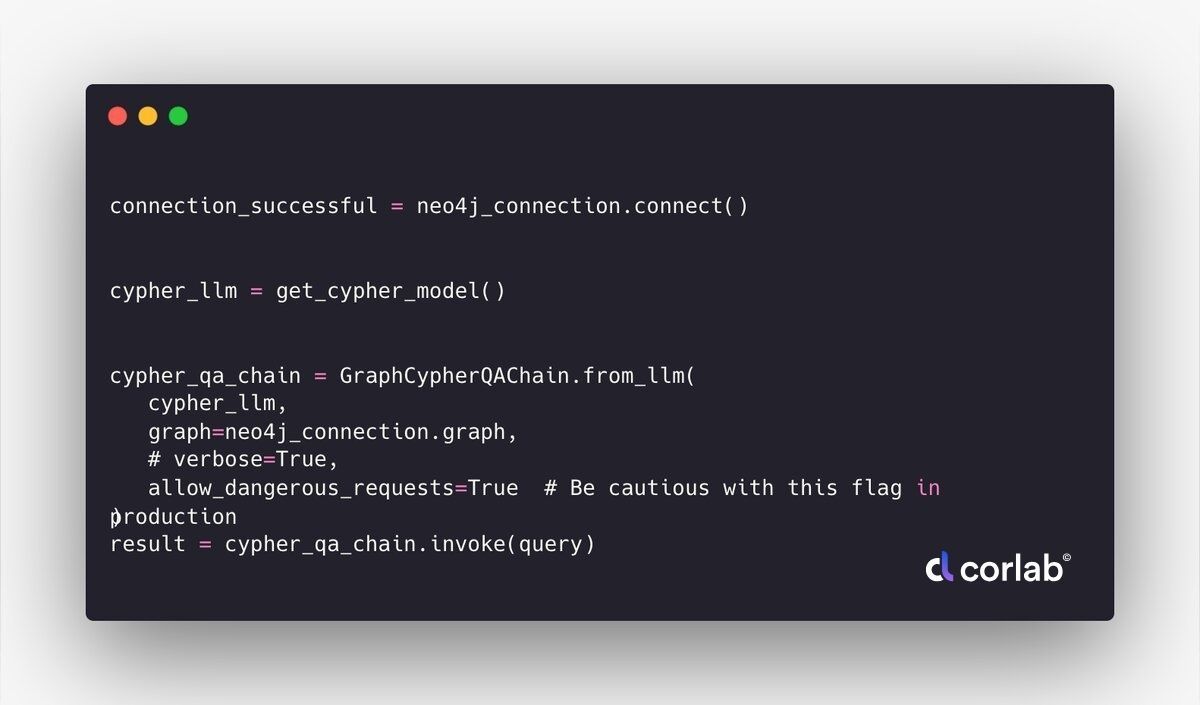
Structured data helps more than clever prompts. A database or graph query returns a record or returns nothing, and an empty result is a useful answer: the application can say the data holds no record instead of letting the model guess. Structured outputs, where the model must fill a defined schema, also make wrong answers easier to catch automatically.
Testing makes the difference visible. A fixed set of real questions, with agreed answers and a few that the sources cannot answer, gives every prompt or model change a score. Showing the source next to each answer lets users check it, and answers that users flag become new test cases. Over time, that set becomes one of the integration's main assets.
What happens when your LLM provider changes the model?
When an LLM provider retires a model, changes a price, or shuts down an API, every feature built on it has to be retested. Lineups change often: Anthropic's pricing page lists more than a dozen Claude models across current and earlier generations. An adapter layer and an evaluation suite turn a forced migration into a routine release.
The changes are concrete. OpenAI's documentation refers to the shutdown of its Videos API on September 24, 2026, and its pricing page says the self-serve fine-tuning platform is being wound down. An application that depended on either had to change.
A thin internal interface between the application and the provider limits the damage. Features call one internal function, and an adapter maps it to each provider's API. Prompts are versioned alongside code, and model names live in configuration rather than scattered through the codebase. Switching providers then touches the adapter and the prompts, not every feature. The adapter is also where token, latency, and error logs belong.
Tool-based designs help too. When a model reaches data only through defined tools, such as a document search or a database query, a newer model can replace the old one without touching the data layer. The evaluation set then answers the one question that matters in LLM app development: does the new model pass?
Self-hosting an open-weight model removes retirement risk and adds operational risk instead. The team now owns GPU capacity, scaling, security patches, and model updates. For most applications with moderate traffic, a hosted API behind a clean adapter is simpler to run. Self-hosting earns its cost when data cannot leave your infrastructure or when volume is very high. Hosting costs also arrive whether or not anyone uses the feature that month.
How do you keep LLM features fast enough for users?
LLM features feel fast when the interface streams answers, uses small models for quick steps, and moves slow work to the background. A long answer that starts quickly usually feels better than a short one after a blank wait. Latency is a design problem as much as an infrastructure one.
Streaming is the first tool. Provider APIs can send tokens as they are generated, over server-sent events or WebSockets. Streaming does not make the model faster. It changes when the user sees the first words, and that shapes perceived speed.
Model routing is the second. A small, fast model can classify the request, pick a tool, or validate a form, and hand only the hard cases to a larger model. Caching helps latency as well as cost, because a cached prompt prefix does not need to be processed again on every request.
Some work should never block the screen. Summaries of long documents, nightly reports, and bulk classification can run as background jobs. Those jobs are also where batch APIs at half price fit naturally, which means the slow path is often the cheap one.
Every LLM call can time out, hit a rate limit, or fail outright, and the interface has to handle each case. A timeout with a retry, a fallback to a smaller model, and a plain message when nothing works are basic requirements. A spinner that never ends is the failure users remember.
How do you protect patient data when using LLM APIs?
Patient data should reach an LLM API only under a business associate agreement that covers the endpoints in use. The application should send the minimum data each task needs, and logging and retention must be configured deliberately rather than left at defaults. That is what a HIPAA-aligned integration looks like in practice.
Provider defaults are a starting point, not a compliance posture. OpenAI's data-controls guide states that API data has not been used to train its models since March 1, 2023, unless a customer opts in. Abuse-monitoring logs are kept for up to 30 days by default. Zero data retention requires OpenAI's approval, and live web search is not covered by its business associate agreement.
A sound pattern is to send less. Remove or replace direct identifiers before a prompt leaves your system, keep the mapping on your side, and re-attach names only in your own interface. Retrieval stores that hold patient data need the same access controls and audit logs as the clinical record itself.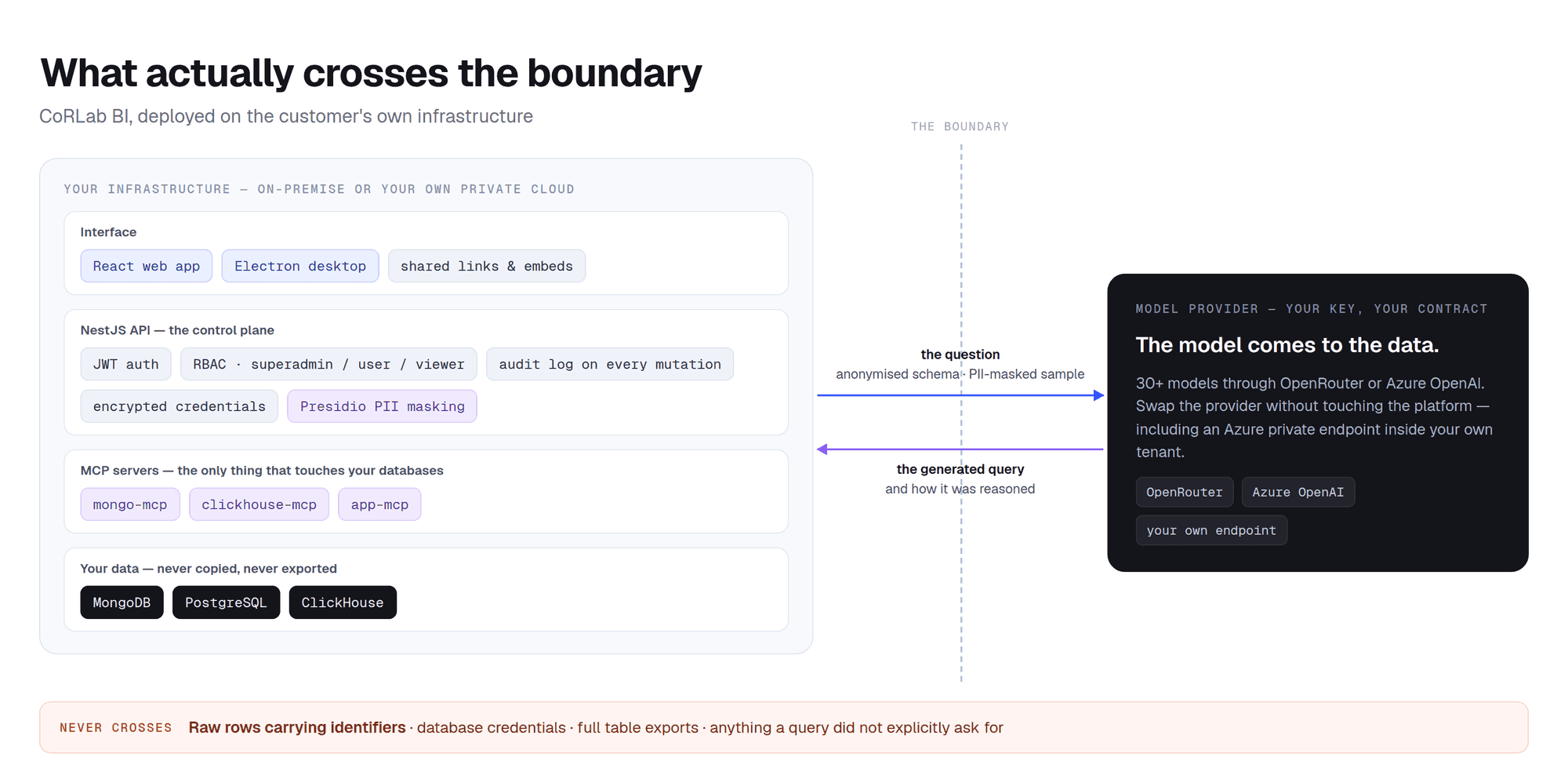
On our healthcare projects, we apply two defaults that carry over directly to LLM features. Development runs against anonymized data, which keeps real patients out of test prompts. Production access is limited to named engineers on the project, logged, and revoked when the engagement ends.
No provider makes an application meet HIPAA requirements by itself. The provider's agreement covers its side, and the application still needs its own access control, audit logging, encryption, and breach process. The accurate description for such a system is HIPAA-aligned, or built to HIPAA requirements.
Patients and clinicians also need to know when a model is involved. Labeling generated text, keeping the reviewer's name on anything that enters the record, and storing which model version produced it make later questions answerable. That record matters when a provider retires the model that wrote last year's summaries.
Which LLM models make sense in 2026?
In 2026, the major LLM providers price their models in three tiers: small, mid-tier, and frontier. Small models cost around $1 or less per million input tokens, mid-tier models $2 to $4, and frontier models about $10. Most production features belong on the small or mid tier, with frontier models kept for complex reasoning steps.
The table lists prices checked on September 28, 2026, on OpenAI's and Anthropic's own pricing pages. Both providers charge half for batch processing and a tenth of the input price or less for cached prompt prefixes. Prices change often, so any estimate should be rechecked against the provider's page before a budget is approved.
Provider | Model | Input | Output | Tier |
| OpenAI | GPT-6 Luna | $0.10 | $0.50 | Small |
| Anthropic | Claude Haiku 4.5 | $1 | $5 | Small |
| OpenAI | GPT-6 Sol | $2 | $10 | Mid-tier |
| Anthropic | Claude Sonnet 5 | $2 | $10 | Mid-tier |
| Anthropic | Claude Opus 5.5 | $4 | $20 | Mid-tier |
| OpenAI | GPT-6 Astra | $10 | $50 | Frontier |
| Anthropic | Claude Fable 5.1 | $10 | $50 | Frontier |
Price per token is only half of the comparison. Output length, how often prompts can be cached, context size, and tokenizer differences all change the real cost of the same task on two models. Running the evaluation set on two or three candidates, with measured token counts, answers the question more reliably than any price table can. A cheaper model per token can cost more per task.
Open-weight models add a self-hosted option, priced in infrastructure rather than tokens, and ChatGPT app development is only one corner of a much wider field. More on how these tools are reshaping engineering work is in the article on the AI revolution in software development, and applied examples are on the artificial intelligence page.
LLM integration is the work of connecting a large language model, such as a GPT or Claude model, to an application's data, users, and workflows so it can answer, summarize, or act inside the product. The API call itself can take an afternoon. Whether the feature holds up in production depends on three decisions.
The first is model choice: which model, from which provider, at what price and speed for each task. The second is data grounding, meaning how the model gets the facts it needs instead of guessing. The third is cost control, or how token usage behaves when traffic grows. This guide covers each decision and the failure modes that follow from it.
Should you use an API, RAG, or fine-tuning?
Most LLM integrations should start with direct API calls and add retrieval only when answers depend on your own data. Fine-tuning fits narrow, stable tasks where the model's behavior, not its knowledge, needs to change. Each step adds cost and maintenance, so the choice follows from where the needed facts live.
A direct API call works when the model already knows enough: rewriting text, classifying support tickets, extracting fields from a form, or drafting a reply that a person reviews. The application sends a prompt and receives an answer. There is no index to maintain, and swapping models later means changing a configuration value and rerunning tests. It is also simple to test, because each call stands alone.
ChatGPT integration services and GPT integration services usually mean this first pattern. The product calls OpenAI's models through the API rather than embedding the ChatGPT app. The same pattern works with other providers, which is why the provider should be a configuration choice from day one rather than a dependency baked into every screen.
Retrieval-augmented generation, or RAG, fits when answers depend on facts the model has never seen: your documents, your product catalog, a medicine leaflet. The application searches a store of your content, passes the relevant passages to the model, and asks it to answer only from them. The model stays general, while the knowledge stays in a system you control and can update.
RAG quality is decided before the model sees anything. How documents are split, which passages the search returns, and whether outdated versions are removed decide what the model can say. A model given the wrong passage will answer confidently from it, so retrieval deserves its own tests, separate from the model's answers.
Fine-tuning retrains a model on examples so it adopts a format, tone, or classification scheme reliably. It does not teach facts well, and it ties the result to one provider's base model. That dependency is real: OpenAI states on its pricing page that it is winding down its fine-tuning platform, which is no longer open to new users.
A practical order follows. Start with prompts and structured outputs, measure quality on a fixed question set, and add retrieval when failures come from missing facts. Consider fine-tuning only when failures come from behavior that prompts cannot fix. Anyone comparing LLM integration services should ask which of these steps a proposal starts with, and why. Skipping straight to fine-tuning usually means paying for a fix before knowing the problem.
Why do LLM costs grow faster than expected?
LLM costs grow faster than expected because every request pays for all the text it sends, including system prompts, retrieved documents, and conversation history. Output tokens cost five times more than input on the models listed below. At scale, prompt size and model choice matter more than the headline price.
Take a support assistant handling 100,000 requests a month, each sending about 3,000 input tokens and receiving 400 output tokens. That is 300 million input and 40 million output tokens. At the Anthropic list price for Claude Sonnet 5, $2 per million input tokens and $10 per million output tokens, the month costs about $1,000. That figure leaves out retries and the embedding calls that retrieval needs.
Model choice moves that figure by two orders of magnitude. OpenAI lists GPT-6 Sol at the same $2 and $10, so the workload costs about $1,000 there too. GPT-6 Luna, at $0.10 and $0.50, brings it to about $50, while GPT-6 Astra, at $10 and $50, raises it to about $5,000. A small model that passes the quality tests is usually the right default.
Caching and batching cut the rest. Both providers bill a cached prompt prefix at a tenth of the normal input price or less. If 2,000 of the 3,000 input tokens are a fixed system prompt, the Sonnet 5 example drops from about $1,000 to about $640 a month, before cache-write charges. Work that can wait, such as nightly summaries, runs through batch APIs at half price.
The numbers that surprise teams come from growth nobody modeled. A chat that resends its full history gets more expensive with every turn. OpenAI charges higher long-context rates once a request passes its standard window, and Anthropic notes that its newer models use a tokenizer that produces roughly 30 percent more tokens for the same text. Estimate from measured token counts, not word counts.
Cost control belongs in the architecture. Set a maximum output length per feature, cap spend per user and per day, and log token usage for every request. Route simple tasks to a small model. A dashboard that shows cost per feature turns a surprising invoice into a line item that someone owns.
How do you stop an LLM from hallucinating in production?
An LLM hallucinates less in production when it answers only from retrieved sources, cites them, and is allowed to say it does not know. Grounding lowers the risk without removing it, so a fixed evaluation set has to measure accuracy before launch and after every change.
Retrieval measurably helps. A 2025 meta-analysis in the American Medical Informatics Association's journal found that retrieval-augmented generation improved model performance on biomedical tasks, with a pooled odds ratio of 1.35 over models without retrieval. That is a real gain and not a guarantee, which is why grounding and testing belong together.
I saw this on the medical AI agent I built in three days. It answered medication questions from leaflets and interaction questions from a knowledge graph. Even with carefully selected documents, I had to test and adjust prompts so it would not invent information when it was unsure, and that tuning is still not perfect. It is still far ahead of a chatbot with no sources behind it.
The same build showed a second kind of error. Letting the model write graph queries freely worked until the schema changed, and then it broke completely. After two frustrating hours of debugging, I switched to LangChain's GraphCypherQAChain, which builds each query against the graph's schema. Finding it was a huge relief.
Structured data helps more than clever prompts. A database or graph query returns a record or returns nothing, and an empty result is a useful answer: the application can say the data holds no record instead of letting the model guess. Structured outputs, where the model must fill a defined schema, also make wrong answers easier to catch automatically.
Testing makes the difference visible. A fixed set of real questions, with agreed answers and a few that the sources cannot answer, gives every prompt or model change a score. Showing the source next to each answer lets users check it, and answers that users flag become new test cases. Over time, that set becomes one of the integration's main assets.
What happens when your LLM provider changes the model?
When an LLM provider retires a model, changes a price, or shuts down an API, every feature built on it has to be retested. Lineups change often: Anthropic's pricing page lists more than a dozen Claude models across current and earlier generations. An adapter layer and an evaluation suite turn a forced migration into a routine release.
The changes are concrete. OpenAI's documentation refers to the shutdown of its Videos API on September 24, 2026, and its pricing page says the self-serve fine-tuning platform is being wound down. An application that depended on either had to change.
A thin internal interface between the application and the provider limits the damage. Features call one internal function, and an adapter maps it to each provider's API. Prompts are versioned alongside code, and model names live in configuration rather than scattered through the codebase. Switching providers then touches the adapter and the prompts, not every feature. The adapter is also where token, latency, and error logs belong.
Tool-based designs help too. When a model reaches data only through defined tools, such as a document search or a database query, a newer model can replace the old one without touching the data layer. The evaluation set then answers the one question that matters in LLM app development: does the new model pass?
Self-hosting an open-weight model removes retirement risk and adds operational risk instead. The team now owns GPU capacity, scaling, security patches, and model updates. For most applications with moderate traffic, a hosted API behind a clean adapter is simpler to run. Self-hosting earns its cost when data cannot leave your infrastructure or when volume is very high. Hosting costs also arrive whether or not anyone uses the feature that month.
How do you keep LLM features fast enough for users?
LLM features feel fast when the interface streams answers, uses small models for quick steps, and moves slow work to the background. A long answer that starts quickly usually feels better than a short one after a blank wait. Latency is a design problem as much as an infrastructure one.
Streaming is the first tool. Provider APIs can send tokens as they are generated, over server-sent events or WebSockets. Streaming does not make the model faster. It changes when the user sees the first words, and that shapes perceived speed.
Model routing is the second. A small, fast model can classify the request, pick a tool, or validate a form, and hand only the hard cases to a larger model. Caching helps latency as well as cost, because a cached prompt prefix does not need to be processed again on every request.
Some work should never block the screen. Summaries of long documents, nightly reports, and bulk classification can run as background jobs. Those jobs are also where batch APIs at half price fit naturally, which means the slow path is often the cheap one.
Every LLM call can time out, hit a rate limit, or fail outright, and the interface has to handle each case. A timeout with a retry, a fallback to a smaller model, and a plain message when nothing works are basic requirements. A spinner that never ends is the failure users remember.
How do you protect patient data when using LLM APIs?
Patient data should reach an LLM API only under a business associate agreement that covers the endpoints in use. The application should send the minimum data each task needs, and logging and retention must be configured deliberately rather than left at defaults. That is what a HIPAA-aligned integration looks like in practice.
Provider defaults are a starting point, not a compliance posture. OpenAI's data-controls guide states that API data has not been used to train its models since March 1, 2023, unless a customer opts in. Abuse-monitoring logs are kept for up to 30 days by default. Zero data retention requires OpenAI's approval, and live web search is not covered by its business associate agreement.
A sound pattern is to send less. Remove or replace direct identifiers before a prompt leaves your system, keep the mapping on your side, and re-attach names only in your own interface. Retrieval stores that hold patient data need the same access controls and audit logs as the clinical record itself.
On our healthcare projects, we apply two defaults that carry over directly to LLM features. Development runs against anonymized data, which keeps real patients out of test prompts. Production access is limited to named engineers on the project, logged, and revoked when the engagement ends.
No provider makes an application meet HIPAA requirements by itself. The provider's agreement covers its side, and the application still needs its own access control, audit logging, encryption, and breach process. The accurate description for such a system is HIPAA-aligned, or built to HIPAA requirements.
Patients and clinicians also need to know when a model is involved. Labeling generated text, keeping the reviewer's name on anything that enters the record, and storing which model version produced it make later questions answerable. That record matters when a provider retires the model that wrote last year's summaries.
Which LLM models make sense in 2026?
In 2026, the major LLM providers price their models in three tiers: small, mid-tier, and frontier. Small models cost around $1 or less per million input tokens, mid-tier models $2 to $4, and frontier models about $10. Most production features belong on the small or mid tier, with frontier models kept for complex reasoning steps.
The table lists prices checked on September 28, 2026, on OpenAI's and Anthropic's own pricing pages. Both providers charge half for batch processing and a tenth of the input price or less for cached prompt prefixes. Prices change often, so any estimate should be rechecked against the provider's page before a budget is approved.
Provider | Model | Input | Output | Tier |
| OpenAI | GPT-6 Luna | $0.10 | $0.50 | Small |
| Anthropic | Claude Haiku 4.5 | $1 | $5 | Small |
| OpenAI | GPT-6 Sol | $2 | $10 | Mid-tier |
| Anthropic | Claude Sonnet 5 | $2 | $10 | Mid-tier |
| Anthropic | Claude Opus 5.5 | $4 | $20 | Mid-tier |
| OpenAI | GPT-6 Astra | $10 | $50 | Frontier |
| Anthropic | Claude Fable 5.1 | $10 | $50 | Frontier |
Price per token is only half of the comparison. Output length, how often prompts can be cached, context size, and tokenizer differences all change the real cost of the same task on two models. Running the evaluation set on two or three candidates, with measured token counts, answers the question more reliably than any price table can. A cheaper model per token can cost more per task.
Open-weight models add a self-hosted option, priced in infrastructure rather than tokens, and ChatGPT app development is only one corner of a much wider field. More on how these tools are reshaping engineering work is in the article on the AI revolution in software development, and applied examples are on the artificial intelligence page.
Frequently asked questions

What is LLM integration?
LLM integration is the work of connecting a large language model to an application's data, users, and workflows so it can answer, summarize, or act inside the product. Integration work covers model choice, grounding the model in real data, and controlling cost. The API call itself is a small part of the work.

How much does it cost to integrate an LLM?
Should you use the OpenAI API or a self-hosted model?
How do you prevent LLM hallucinations in production?
Is it safe to send private data to LLM APIs?
When is fine-tuning worth it?
How long does an LLM integration project take?

Author
With more than 10 years in full-stack development and real-world experience in healthcare, I bring a unique blend of technical skills and domain knowledge to every project. My focus is on building solutions that solve real problems and support better outcomes.
I often bring AI into the mix to enhance performance and simplify the complex. It’s all about creating smarter tools that help people work more efficiently and make better decisions.


Thinking about building your own app?
Let's make it happen! Dream big, build smart - we’ll take care of the tech.
 Get a free consultation
Our Best Insights
Browse More Articles
Want to know what’s trending in the tech world? Our articles break it all down - quickly and clearly.
 Time to read: 11 min
Healthcare

Software Development
December 30th, 2024
Mental Health App Development: Integrations, Compliance, and Build Process
Building a mental health app? Discover the tech stack, key integrations, and development process for secure, user-friendly telepsychiatry software.

 Time to read: 11 min
Healthcare

Artificial Intelligence
November 4th, 2024
Machine Learning in Healthcare: Benefits, Use Cases, and Limits
Where machine learning helps in healthcare, why so many projects stall after the pilot, and when a simple rule beats a model.